Guyana’s Gold Is Now Flowing Into Venezuela, Paid in Crypto, Says a New Report. The GGMC’s Paper Ledgers Cannot Keep Up
A GI-TOC and SWISSAID investigation says Guyanese gold is being smuggled through Boa Vista into Venezuela, with crypto payments bypassing banks. It also exposes weak record-keeping at the GGMC.
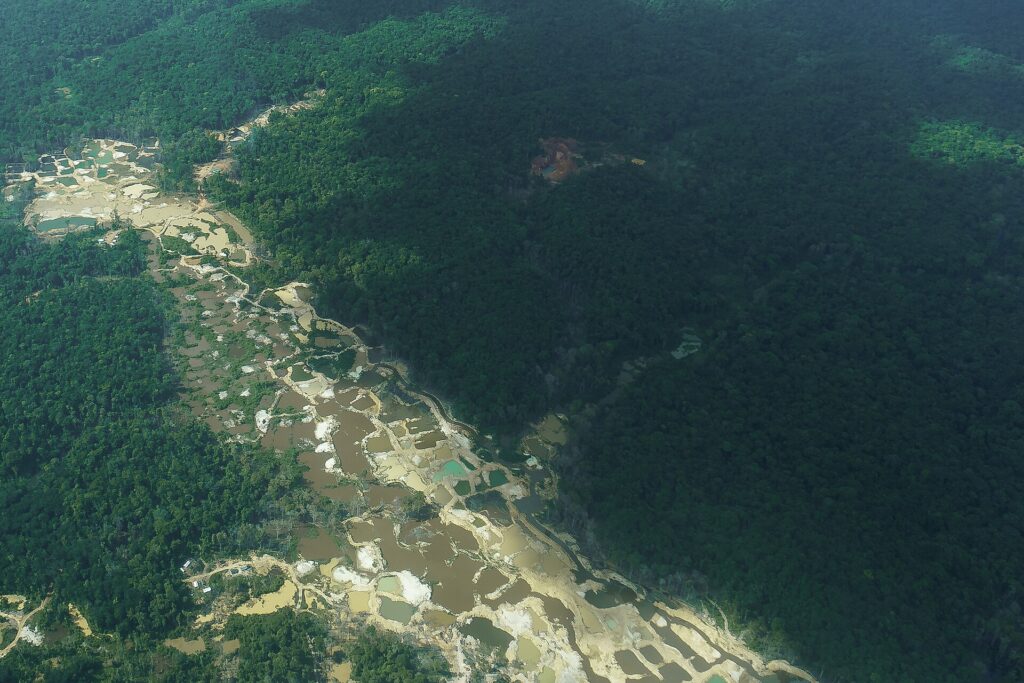
For years the story was that gold from Brazil and Venezuela was smuggled into Guyana. A new international investigation says the river has reversed. Guyanese gold, it reports, is now moving out through Lethem to Boa Vista in Brazil and on into Venezuela, with cryptocurrency payments letting the proceeds slip past the formal banking system altogether.
The findings come from a November 2026 investigation by the Global Initiative Against Transnational Organized Crime and SWISSAID. If they are right, Guyana is losing gold, tax revenue and control of one of its oldest industries to networks it has barely begun to map.
How The Route Works
According to the report, during part of 2024 and throughout at least 2025, traders and dealers moved gold out of Guyana towards Boa Vista, a city roughly 100 kilometres from both Guyana and Venezuela, with highway links to each. There, brokers, pawn shops and jewellery stores reportedly buy artisanal and illicit gold without properly checking where it came from. One law enforcement official is quoted as claiming that luggage on private flights into Boa Vista’s airport is not scanned.
The report says the gold is processed in local foundries owned by influential elites into bars of about 98 per cent purity, then trafficked into Venezuela. There, it says, much of it is bought by Venezuelan generals in Las Claritas, a major illicit mining hub in Bolívar state, at about 8 per cent above international prices. Some is held as reserves; some is exported to markets including China, Switzerland and the United Arab Emirates. Brazil’s Primeiro Comando da Capital and Comando Vermelho are reported to be buying businesses in the area, and Venezuela’s Tren de Aragua operates in the wider tri-border region.
Researchers said the shift was driven partly by that Venezuelan premium and partly by tougher enforcement against illegal mining in Brazil.
The Weak Link Is At Home
The most uncomfortable part of the report is not about generals or gangs. It is about the Guyana Geology and Mines Commission. Researchers said the GGMC has historically relied on paper records to track legal mining and gold sales, despite digitisation efforts. They found discrepancies between miners’ production books and the commission’s purchasing records, with reporting often missing or incomplete. Their conclusion is blunt: official figures may only reflect what miners and traders choose to declare. There are no reliable figures for artisanal and small-scale production at all.
The report also questioned the allocation of mining permits on a first-come, first-served basis rather than through competitive tender, and noted that although the GGMC is partly funded by a 5 per cent levy on legal gold sales, it has not fixed long-standing monitoring weaknesses.
Who Should Answer
None of this proves wrongdoing by any named Guyanese official, and the report’s claims about specific dealers deserve a full response from those involved. But the systemic picture is damning enough. A country that cannot say with confidence how much gold it produces cannot say how much is being stolen.
The government should treat this report as an audit it did not have to pay for. Digitise the GGMC’s records fully and quickly. Reconcile production books with purchases in real time. Put scanners and customs officers where the gold actually moves. And ask Brasília and Caracas, publicly, what they intend to do about the buyers on their side of the border.