THE POLITICAL drama in Venezuela, where a populist, authoritarian government is attempting to cling to power despite losing a legislative election by a landslide, tends to obscure a deeper crisis. Though it is awash in oil, the country of 30 million people is facing an economic collapse and a humanitarian disaster.
Venezuela already suffers from the world’s highest inflation rate — expected to rise from 275 percent to 720 percent this year — one of its higher murder rates and pervasive shortages of consumer goods, ranging from car parts to toilet paper. Power outages and the lack of raw materials are forcing surviving factories and shops to close or limit opening hours. According to a local survey cited by the Economist, the poverty rate is 76 percent, compared with 55 percent when Hugo Chávez, the late founder of the regime, took power in 1999.
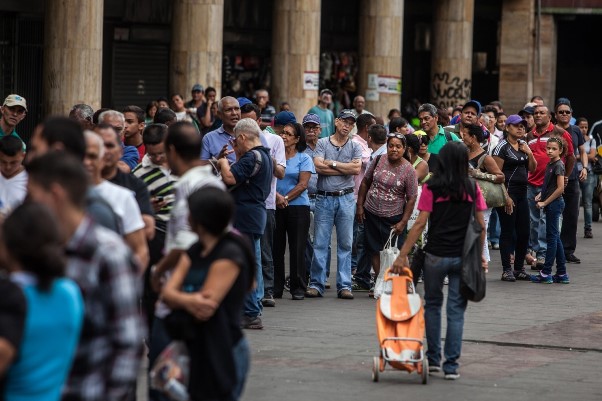
Worst of all, the country is running desperately short of food and medicine. Venezuelans spend much of their time waiting in lines outside stores, but increasingly the shelves are bare. The head of the nation’s pharmaceutical association recently appealed to the World Health Organization for aid, saying that distribution of 70 percent of basic medicines was disrupted. The chairman of the largest domestic food producer has said that if the government does not quickly seek aid to import food, it “will cause grave harm to ordinary Venezuelans.”
The math behind these warnings is stark, as economist Ricardo Hausmann recently outlined in the Financial Times. At current oil prices, Venezuela will earn less than $18 billion from exports this year, while it owes $10 billion in payments on the $120 billion in debt it has racked up. That leaves $8 billion for imports, but even after contracting 20 percent, imports were $37 billion in 2015 — and Venezuela now imports most of its food. Even with a debt default that the markets expect, it’s hard to see where additional hard currency will come from: The country broke relations with the International Monetary Fund almost a decade ago, has no ability to obtain private loans and has nearly exhausted its liquid reserves. It already owes China, its latest benefactor, $50 billion.
Facing this calamity, the government of President Nicolás Maduro appears paralyzed. Mr. Maduro and one of his ministers have spoken of taking desperately needed common-sense measures, such as raising the price of state-retailed gasoline, now below 1 cent per gallon, and altering a currency exchange system under which the U.S. dollar is worth 150 times more on the black market than it is at the official rate. Day after day, however, the government does not act; in a Facebook post Wednesday, Mr. Maduro hinted at disputes among his ministers, one of whom argues that inflation does not exist. Article courtesy https://www.washingtonpost.com