US$10 Million to Fight 37 Million Tonnes of Sargassum: The Caribbean Gets a Project, Not a Solution
CAF and the Global Environment Facility have launched SargMarine, a US$10 million regional project on sargassum, at COP31. Against 37.5 million tonnes of seaweed, the sum is tiny.
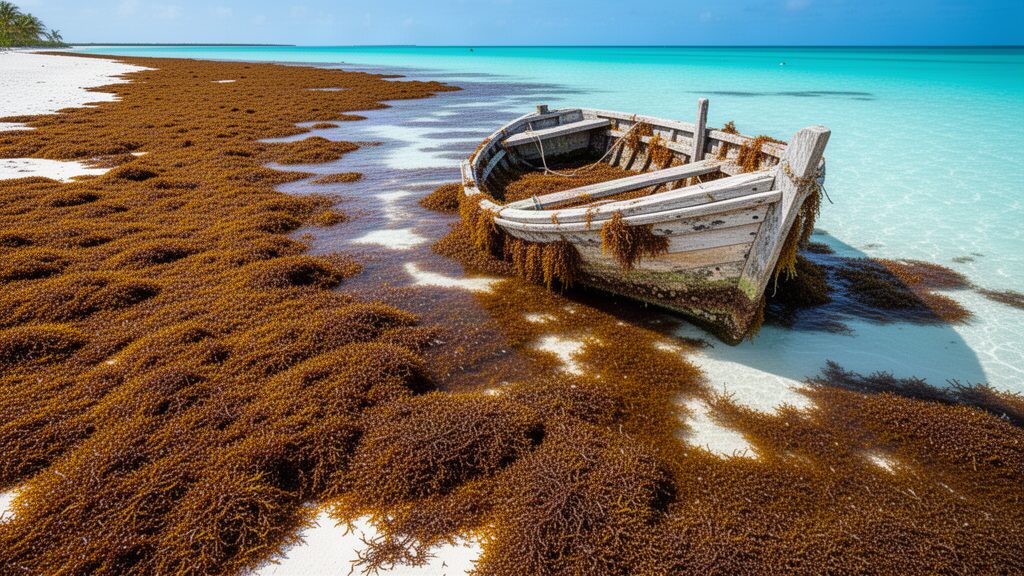
In May 2025, scientists recorded 37.5 million tonnes of sargassum in the Atlantic, the most since monitoring began in 2011. This week, at the COP31 climate summit, the international response was unveiled: a regional project with a US$10 million grant. Do the division. That is about 27 US cents for every tonne of seaweed, before a single consultant has been paid.
What was announced
The project is called SargMarine. It was presented by CAF, the Development Bank of Latin America and the Caribbean, and the Global Environment Facility, with the support of Mexico and France. The GEF is providing the US$10 million grant, and the plan envisages a further US$67.3 million in co-financing. CAF will be the implementing agency, the Organisation of American States the executing agency and the Inter-American Institute for Global Change Research a technical partner. Regional coverage reports that seven countries will be supported.
Its aims are to help countries share information, strengthen their ability to anticipate and manage influxes, and develop productive uses for the weed that could create local economic opportunities. “Sargassum is a transboundary phenomenon, but our responses remain largely national,” said Lina Mondragón of CAF. “Overcoming this fragmentation requires strengthening existing mechanisms.” A GEF manager, Chizuru Aoki, said the initiative has final approval: “We are ready to drive action on the ground.”
What is right about it
The diagnosis is sound. Sargassum does not respect maritime boundaries, and for more than a decade each island has fought it alone with rakes, booms and whatever the tourism budget could spare. Shared forecasting would let hotels, fishers and governments prepare weeks ahead instead of waking up to a brown shoreline. Finding a commercial use for the stuff would turn a clean-up bill into a business.
What is wrong with the scale
Now look at the money honestly. Ten million dollars across seven countries is well under a million and a half each, and that is before the implementing agency, the executing agency and the technical partner take their costs. Three institutions sit between the grant and the beach. The Caribbean has long experience of projects in which the workshops, studies and coordination meetings are fully funded and the equipment never arrives.
The US$67.3 million in co-financing is the figure to watch, and the word to watch is “envisages”. Co-financing in development-speak often means money governments were already spending, relabelled, or commitments that have yet to be made. The announcement does not say who is putting it up.
Compare the sum with the damage. A single bad season costs Caribbean tourism and fisheries far more than US$10 million in cancelled bookings, lost catch and clean-up crews. One territory alone, the British Virgin Islands, has just earmarked US$1 million of its own for sargassum management.
The test
None of this means turning the money down. It means refusing to applaud until there is something to see. Governments in the seven countries should demand a public breakdown: how much reaches coastal communities as equipment and jobs, how much goes on administration, and when the forecasting system goes live.
The sargassum is arriving on schedule every year. The project meant to meet it should be judged by tonnes removed and warnings issued, not by the quality of its launch at a summit.