‘We Weren’t Treated Like Human Beings’: The MV Barima Inquiry Is Hearing How a State Ferry Was Loaded to Sink
Survivors told the MV Barima Commission of Inquiry of extreme overloading, cash fares with no tickets or manifest and an engine fault left unrepaired before the state ferry capsized.
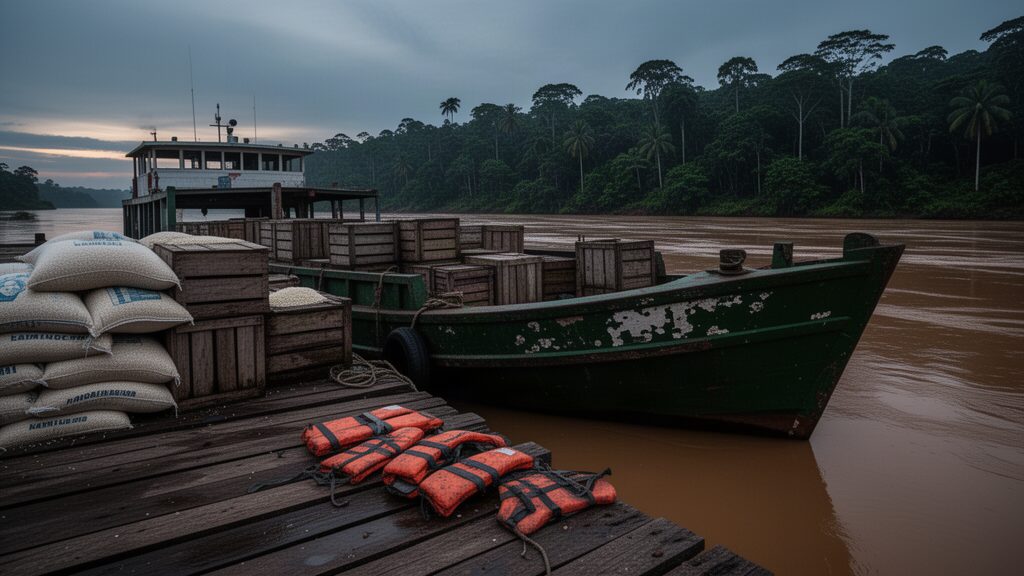
The MV Barima did not go down because of bad luck. If the testimony now before the Commission of Inquiry holds, it went down because the people running a state-operated ferry packed it past sense, sold passage for cash without paperwork and sent it out with an engine they had been warned about.
A boat stacked to the roof
The five-member commission, chaired by retired Justice Godfrey Smith, sat at the Arthur Chung Conference Centre on Friday to examine the 18 July 2026 sinking. A trader who has ridden the Barima every fortnight for more than 15 years told it he had never seen the vessel so overloaded. Holds, passenger areas and even the roof above the captain’s bridge were packed with pipes, tanks and a heavy generator lifted aboard by forklift. Groceries were stacked floor to ceiling on and behind the benches.
He said he warned the marine superintendent before departure that passengers would be trapped in an emergency. When the vessel rolled, he testified, the generator burst its straps and pushed the ferry over, and it never came back up. He surfaced without a life jacket, clinging to a pail, and explained that corks are removed at the wharf to stop theft. “We weren’t treated like human beings,” he told the commissioners.
No ticket, no manifest, no record
A family from Port Kaituma described being told tickets were sold out around midday, then being waved aboard without one at about 1:30pm and paying cash on board with no ticket and no freight receipt. Asked whether their names had been written down anywhere before sailing, the answer was blunt: no documentation. An eight-year-old relative travelling with them died.
That detail should stop every official in the transport ministry cold. A ferry that does not know who is aboard cannot know who is missing. Witnesses spoke of talk of 144 people on board and around 40 more waiting. Nobody, it seems, could say for certain.
Other survivors described cargo including drums, a freezer and small gas cylinders stored near the canteen, and one said he saw what he believed were explosives being loaded. A survivor who lost two young relatives said the same vessel had engine trouble on a trip two weeks earlier, slowing as if it would cut out, and was not repaired in Georgetown. A Guyana Defence Force corporal corroborated that one engine failed around 6pm after the 4pm departure. Another witness said a pilot later admitted he had dodged a distress flare because nobody had told him the boat had sunk.
Who answers for this
These are accounts, not findings, and the commission must test them. But the pattern is already damning. Overloading, cash fares off the books, missing flotation and a known mechanical fault are not the failures of one crewman. They are the failures of a system the state owns and the state is supposed to inspect.
The people of Port Kaituma and Mabaruma depend on this route because there is little else. They were treated as freight. When the commission reports, its recommendations must name the managers and regulators responsible for the rules that were ignored, and the government must fund the fixes before another boat leaves that wharf. Anything less will be an insult to the families who sat in that conference centre and relived the night.