

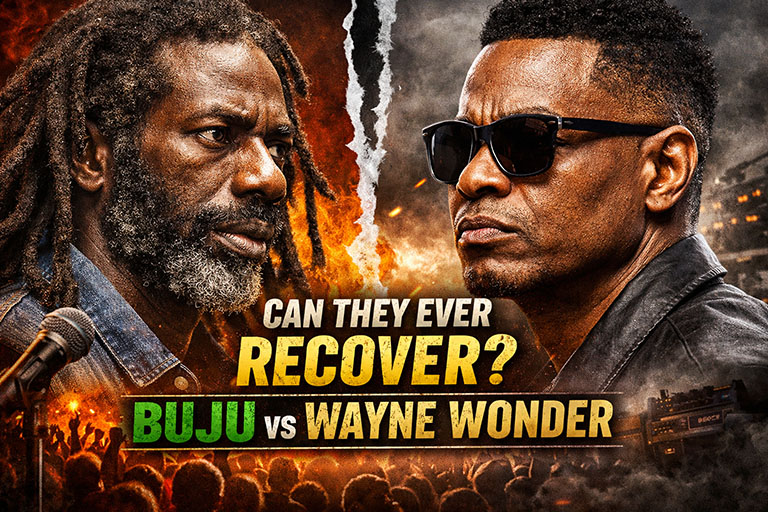

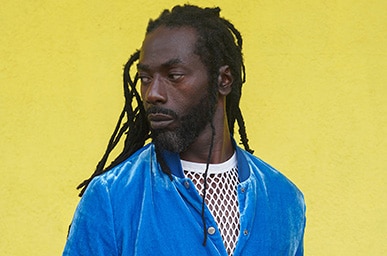
The Beginning Was Beautiful — Which Is Why The End Hurt So Bad
Before Buju was Banton the legend, before Wayne Wonder was the smooth-voiced hitmaker that made every woman lean on a wall at a dance and close her eye — they were just two youth from Jamaica. Running the same road. Sharing the same dream. You used to see one, you see the next. That is not gossip. That is documented history.

People who were around back then will tell you: these two men were twin. Every way you see one, you see the next. Wayne used to pick Buju up, carry him to shows, carry him to studio sessions, carry him everywhere — back when Buju never even have a car to his name. That bicycle ride from Parkland to Liggony? That is Wayne Wonder story. Sitting on steps for hours waiting for Buju to wake up, then leaving the bicycle there for weeks while Buju carried him everywhere in his car, sharing the little he had.
When Buju had nothing, Wayne Wonder was there.
Remember that. Because that is the foundation this whole fire is burning on.
The Song That Started Everything: “Murderer”
Now here is where it gets dark, Jamaica.
In 1992 — in a hotel room in Tokyo, Japan — three men wrote a song together. Buju Banton. Wayne Wonder. And a man named Frankie.
That song became Murderer. One of the most iconic records in the history of reggae and dancehall. A song the world knows. A song that still gets played at parties, at tributes, at vigils. A song that represents something enormous in the culture.
Buju himself confirmed it — on record, on camera. He said he was in Tokyo, got news from a friend, went to the hotel room, and wrote the song. He mentioned Frankie. He mentioned the process. The creative team was clear.
Now here is where the story turns sinister.
In 1995, when Buju Banton signed his major record deal, something happened quietly. No announcement. No phone call. No letter. Wayne Wonder’s name was removed from the writing credits of Murderer.
Thirty years passed.
Wayne Wonder’s name continued to appear on his own royalty statements — creating the illusion that he was being compensated — while the actual licensing and collection arrangement told a completely different story. He was getting breadcrumbs while the full meal was being eaten elsewhere.
It wasn’t until a production company approached to license Murderer for a movie that Wayne Wonder’s people looked deeper and discovered the truth: his name had been quietly removed from the foundational paperwork. Over three decades of royalties — gone. Collected. And Wayne never knew.
Ask yourself something. In 1995, when Buju signed that deal, who made the decision to remove Wayne’s name? Was it the label? Was it the management? Or was it the man who was there in that Tokyo hotel room when the pen touched the paper?
Jamaica, that is the question that nobody wants to answer directly. But everybody is thinking it.
Buju Comes Home — And The First Disrespect Lands Immediately
When Buju Banton walked out of a United States federal prison after serving roughly ten years on drug conspiracy charges, Jamaica rejoiced. The whole island moved. People cried. The culture exhaled.
And Wayne Wonder, quiet and dignified as he has always been, was ready to be part of that welcome home.
But instead of a phone call from his brother — the man who sat on steps waiting for him, the man who shared everything — Wayne Wonder got a call from Buju’s manager, Jermaine.
Not Buju. Jermaine.
Buju’s manager called to invite Wayne to be part of the peace concert, the first show back in Jamaica. Wayne Wonder, who rode his bicycle from Parkland to be near this man, who waited on steps, who lent his car, who contributed to the song that would define Buju’s legacy — he had to receive a call from an intermediary.
That is not how you treat a friend. In Jamaican culture, in reggae culture, in any culture that understands loyalty — that is a cut. A deliberate one.
Wayne expressed this. Quietly. In interviews. Without venom. He said: “Tell me himself, man.”
That’s all. Four words. And Jamaica, those four words held thirty years of love, expectation, and disappointment.
Buju’s Silence Was Not Peace — It Was Resentment Being Stored
For a while, the public watched Wayne give interviews about how things changed, how the friendship cooled, how he felt disrespected. Many people said: “Buju ah play the bigger man. Him nuh respond.”
That was wrong.
What was actually happening, according to people who studied the situation closely, is that Buju was building resentment in silence. And when he finally did speak — on the Queen Slip interview — he chose to not just address the situation. He chose to diminish Wayne Wonder. To minimize his contribution. To rewrite the narrative of a friendship that Wayne had been quietly protecting for years.
That is when Wayne Wonder’s wife, Jackie, stepped forward.
Jackie Opens The Gates of Hell — And Buju Is Not Ready
Jackie’s statement — which she kept online for only 48 hours, calling Buju a “demon” not worthy of a permanent place on her page — did not just defend her husband. It detonated a bomb under everything Buju had been presenting to the public about who he is.
She confirmed: Wayne came to see Buju in Tampa jail. When Buju was brought out and picked up the phone, he saw Wayne on the camera. And — according to Jackie — Buju held his head down for almost twenty-five minutes before finally acknowledging him.
Twenty-five minutes.
Think about that. Your bredrin, the man who shared everything with you, comes to see you in federal prison. And you can’t even lift your head for twenty-five minutes.
Jackie went further. She said Wayne came to visit multiple times when Buju was released on bail and placed under house arrest in Tamarac, Florida. Wayne came almost every morning. He spent entire days with Buju while police monitored the house during the trial. He was consistent. He was loyal. He was there — right up until the day Buju was found guilty and taken back into custody.
And he came again. That same day.
Now you tell me — which man was the friend in this relationship? Because one of them was consistent right through the darkest chapter, and the other one, when things got bright again, removed a name from a paper and acted like the other man never existed.
The Allegations Nobody Is Talking About Loudly Enough
Jackie’s statement didn’t stop at loyalty and betrayal. She went somewhere darker. She invoked a woman named Lana — someone who reportedly took care of Buju from age 18 to 36.
When Buju allegedly spoke about Lana in his response, Jackie fired back with accusations that — if true — paint a picture of this man that goes far beyond a music publishing dispute. She alleged a bullet still sits in a roof from an incident involving this woman. She alleged three men were allegedly sent to this woman. She alleged Lana was hungry and had to do things she shouldn’t have had to do just to feed her children.
These are serious allegations. Whether they are legally supportable is a matter for courts, not podcasts. But the fact that someone who claims to have known Buju for over thirty years is saying these things publicly — that matters. That cannot simply be waved away as “woman war.”
And then Jackie called out names. Places. Incidents in Trinidad. Bermuda. A flight attendant. She said Buju’s “file” has numbers attached to it that his team would rather keep private.
Is this a scorned woman swinging blindly? Or is this someone who has watched a man be protected by reputation and silence for decades and decided the silence was over?
Jamaica will have to make that judgment for itself.
The God Complex That Prison Should Have Broken — But Didn’t
Here is something that is uncomfortable to say about a man whose music we love.
People who study behavior and psychology — not just gossip — have observed that Buju came out of prison more convinced of his own infallibility, not less. The humility that prison should have brought, the reckoning that ten years in a federal facility should produce, does not seem to have fully arrived.
Instead of coming home and acknowledging what friends gave up while he was away, Buju came home and began — slowly, methodically — rewriting who helped him and who didn’t. Instead of remorse about the drug conviction, he deflected. He said “trust no phone.” He campaigned around innocence. He didn’t write the letter. He didn’t make the call himself.
A man who spent ten years in a federal prison and comes out talking about everyone’s shortcomings while acknowledging none of his own — that is not strength. That is a man who built walls instead of wisdom in that cell.
Wayne Wonder is not a perfect man. No artist is. But the public record shows a man who gave quietly, visited faithfully, and spoke carefully — even when he had every reason to detonate. His wife detonated on his behalf. That is its own conversation. But the underlying pain? That is real.
Can They Ever Recover?
Honestly? In the current climate? No.
Not because the wound is too deep — though it is. Not because the royalties issue is too complex to resolve — though it is. But because the ego involved on one side has not shown a single sign of bending.
Recovery requires two things: acknowledgment and accountability. One man has shown he can articulate pain. The other has shown he can articulate grievance against everyone else but himself.
For this to heal, Buju Banton would have to say something Jamaica has almost never heard him say: I was wrong. I benefited from something that wasn’t fully mine. I should have called him myself.
That is not a complicated statement. It is, in fact, the minimum. But for a man who — by multiple accounts — has developed a way of seeing the world in which his greatness excuses his behavior, that minimum might as well be a mountain.
Wayne Wonder, for his part, may have already made his peace. Not the public performance of peace — the real kind. The kind where you stop expecting the apology and start living your life without it.
And perhaps that is the saddest part of this story. Not the feud. Not the royalties. Not even Jackie’s statement.
The saddest part is that one man waited twenty-five minutes in a Tampa jail for his bredrin to lift his head — and that bredrin never really did.
The Lesson Jamaica Must Take From This
Stop waiting for superstars to be human beings just because their music moved you.
Buju Banton’s music is transcendent. Untold Stories will outlive all of us. Til Shiloh is scripture in sound. None of that is being taken away.
But the man who made the music and the music itself are not the same thing. One is art. The other is a human being with flaws, blind spots, and apparently — if the evidence is to be believed — a capacity for gratitude that has an expiration date.
Wayne Wonder built the bridge. Buju Banton walked across it, then set it on fire — and has spent years telling people there was never a bridge.
Jamaica is a small place. The music community is smaller. And time has a way of making sure that what was done in the dark eventually finds daylight.
The song is called Murderer.
The irony writes itself.
