Exxon Marks Its Own Homework: Guyana’s Longtail Permit Lets the Oil Giant Report Its Own Waste
The EPA's Longtail permit requires ExxonMobil to measure and report its own waste discharges and even its own breaches. Guyana can afford independent monitoring. Why isn't it doing it?
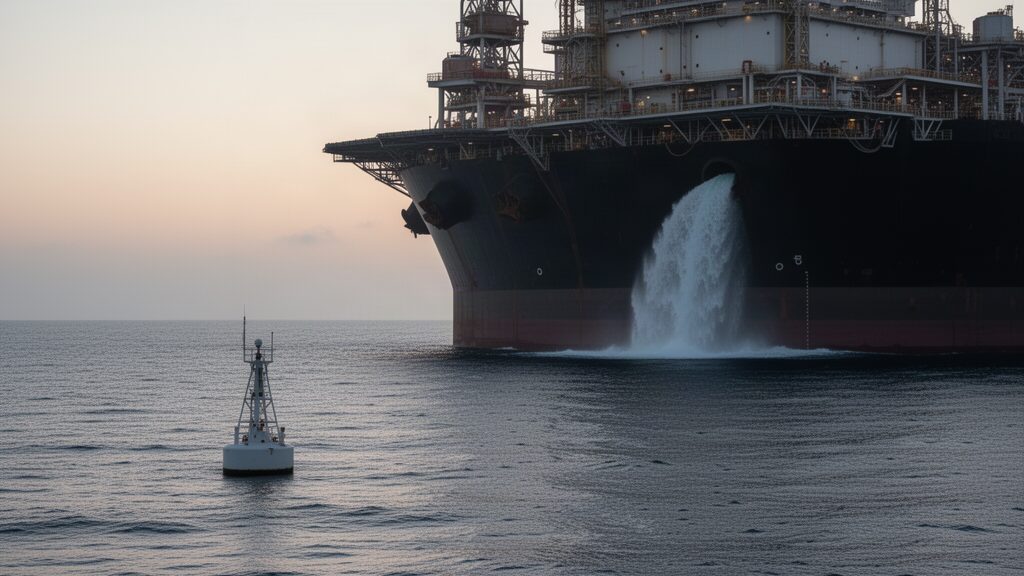
Guyana has handed ExxonMobil a pen and asked it to grade its own environmental exam. The permit for Longtail, the eighth offshore project the government has approved, requires the company to measure and report its own discharges into the sea, and to tell the regulator when it breaks the rules.
That is not regulation. That is an honour system for one of the largest oil companies on earth.
What the Longtail permit says
According to the permit issued by the Environmental Protection Agency (EPA), the operator must monitor and report the temperature of cooling water it pumps overboard, daily, as part of its production summary. It must fit every continuous overboard stream with a way to measure temperature as near the discharge point as possible. On oil in produced water, the permit caps Exxon at 42 milligrams per litre on any day and 29 milligrams per litre as a monthly average, and again the company does the sampling and sends the results in.
The list of waste streams Exxon will police itself on is long: cooling water, bilge water, brines from sulphate removal and drinking-water processing, grey and black water, slop tank waste and produced water. These streams can carry highly toxic chemicals. The company is also told to run random tests on produced water for other contaminants and report those too, file a monitoring report every six months and an annual compliance report by 31 March.
Most telling of all, condition 13.6 asks the permit holder to report its own non-compliance within 24 hours of becoming aware of it. Another condition asks the company to support training for EPA staff “where necessary and practicable”. The regulated is now helping to train the regulator.
The EPA’s defence
The agency is not without an answer. Section 15.5 of the permit lets it order sampling of any discharge by an independent certified institution, at Exxon’s expense. In earlier statements the EPA has said it uses continuous satellite monitoring to spot oil sheens, thermal imaging to catch gas flaring, and receives a live feed of produced-water releases from the production vessels.
Fine. Then the EPA should publish how often it has used its section 15.5 power, what independent samples have found, and how its satellite data compares with what Exxon reports. A reserve power that is never used is decoration. Satellite images of surface sheen tell you nothing about the temperature or chemistry of water being pumped below the surface.
Who gains, who carries the risk
The arrangement suits the company perfectly: it controls the data, the timing and the framing of anything that goes wrong. It suits a thinly staffed regulator, which gets to tick a box without building the laboratories and inspection teams a petrostate needs. It does not suit the fishing communities along the coast, or the country that will live with the ocean long after the oil is gone.
Guyana now has eight approved projects and the revenues to fund a proper, independent monitoring service many times over. Choosing instead to trust the operator is a political decision, not a technical necessity. Parliament should demand the EPA’s independent sampling record, and the EPA should stop treating Exxon’s own numbers as the last word.