Newton Memorial Barbados: 570 Posts for 570 Enslaved Africans, and a Debt That Words at a Ceremony Cannot Settle
Barbados has opened the Ancestral Memorial of the Enslaved at Newton Plantation, marking about 570 burials. It is a powerful act of remembrance, and a test for the reparations campaign.
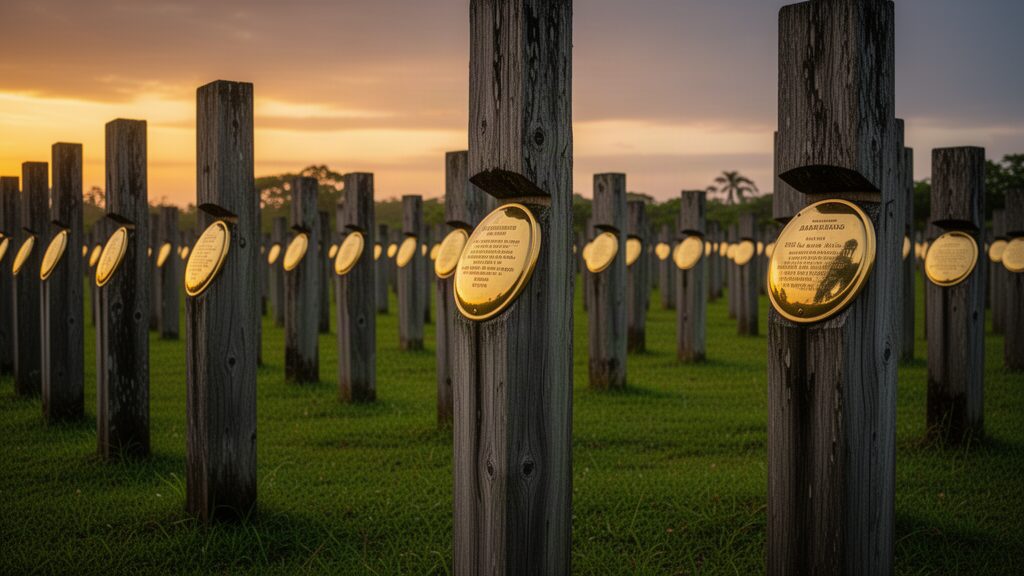
The Newton memorial in Barbados does what history books rarely manage: it makes you count. Five hundred and seventy timber posts, each cut from wood brought from Ghana, stand in a field beside the burial ground at Newton Plantation in Christ Church, one for each enslaved person researchers have identified buried there.
On Saturday evening President Jeffrey Bostic, Prime Minister Mia Mottley and Ghana’s President John Dramani Mahama, with other Caricom leaders, opened the Ancestral Memorial of the Enslaved, two days before Barbados marks 60 years of independence and five as a republic. It is part of the Government’s Reclaiming Our Atlantic Destiny programme and opens to the public on 1 December.
What We Know So Far
The site is the largest and earliest known plantation burial ground for enslaved Africans in Barbados, in use from the 1630s until 1838. The burials were identified using ground-penetrating radar and a laser survey. Visitors enter through a monolithic domed pavilion that explains the site and the slave trade before walking out among the posts, each capped with a circular brass plate angled to catch the sun.
Excavations in the early 1970s had already told part of the story. In two graves archaeologists found necklaces each holding a reddish-orange carnelian bead, a stone that does not occur naturally in Barbados. The archaeologist Jerome Handler traced them to workshops in what is now Gujarat in India. The consecration on Saturday began with a libation and interfaith observances, with drummers, dancers and singers.
The day before, Mahama and Mottley unveiled a statue of King Cuffee in Speightstown. Mahama described Cuffee as an Akan elder from the Gold Coast, enslaved in Barbados and remembered for resisting slavery. The two leaders also witnessed the twinning of Speightstown with Cape Coast in Ghana.
Remembrance Is the Easy Part
This is a serious, beautiful piece of national memory, and Barbados deserves credit for building it with care rather than slapping a plaque on a wall. A single brass-capped post per person refuses the anonymity that slavery imposed. The Ghanaian timber turns the Atlantic crossing into something physical.
But memorials are where governments are most comfortable, because they cost a fraction of what is owed and ask nothing of those who profited. The same week, Antigua and Barbuda’s Prime Minister Gaston Browne said he hoped a framework for reparations talks with Britain could be ready by the end of the year, with Mottley, who holds the reparations brief in Caricom, playing a leading part.
The Newton Memorial and the Reparations Test
That is the right sequence: memory first, then the bill. The danger is that the region stops at the first stage. Every leader who stood among those 570 posts on Saturday should be judged by what they deliver at the negotiating table, not by the eloquence of the speeches in Christ Church.
For Barbadians visiting from Tuesday, the site will speak for itself. For London, the message should be just as plain. The dead at Newton have now been counted. The accounting is not finished.