$200,000 for School Farms in St John Is the Kind of Food Security Spending Barbados Should Be Doing Everywhere
A GEF-backed project worth about $200,000 is building aquaponics, shade houses and solar-powered poultry units at three St John schools. It is the food security model Barbados should be funding nationwide.
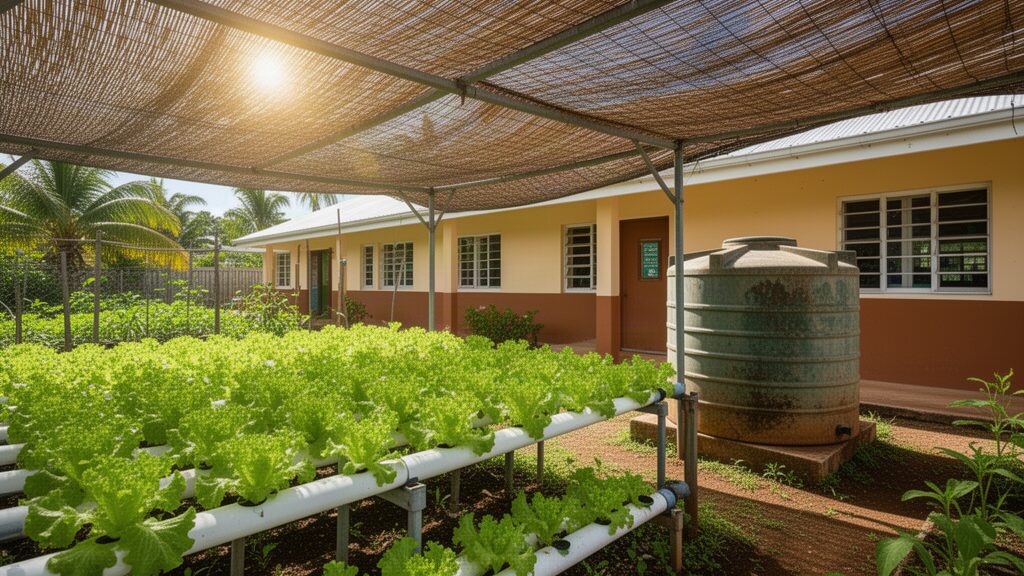
Barbados imports most of what it eats and talks endlessly about fixing that. In three schools in St John, somebody is actually doing it, with water tanks, shade houses, solar panels and children who are learning that food does not begin in a supermarket.
The St John Learning Entrepreneurship and Environmental Protection project, known as LEEP, is backed by the Global Environment Facility Small Grants Programme, which the United Nations Development Programme administers. Members of the programme’s National Steering Committee toured it on Friday at Mount Tabor Primary School, along with the Sojourner Foundation at Turners Hall Woods in St Andrew.
What The Money Buys
The programme’s national coordinator, Dr David Bynoe, said the St John project, led by the St John Development Council with Youth Equipped to Achieve, received about $100,000 in grant funding and mobilised another $80,000 in co-financing. The overall value across three schools, Mount Tabor Primary, St Margaret’s Primary and The Lodge School, is about $200,000.
Mount Tabor will get a water-harvesting system, an outdoor classroom, and aquaponics and hydroponics systems. The Lodge School is using solar panels to light its poultry production area and power water management, including an energy-efficient pump. St Margaret’s has built a shade house for protected agriculture. Bynoe said the project should build capacity among about 50 to 60 young people and encourage the schools to share tools, equipment and training.
“They’re learning the science behind agriculture. They’re also learning entrepreneurship at the same time,” he said.
Why It Deserves More Than A Tour
This is a small project with a big argument behind it. Bynoe pointed to the obvious problem: Barbados depends heavily on imported food and has limited land. The answer cannot just be bigger farms. It has to include more people who know how to grow food intensively on small plots, using little water and clean energy. Aquaponics, hydroponics and shade houses are exactly those techniques, and teaching them to primary school children is the cheapest workforce training the country will ever buy.
The programme also says it monitors projects throughout rather than waiting until the end, with reports and site visits. That is a better standard than much government spending meets, and it is worth noting.
The Uncomfortable Comparison
Here is the problem. This is roughly $200,000 for three schools, raised partly through international grant money and partly through local co-financing. Barbados has dozens of schools. If the case for school-based agriculture is as strong as everyone on Friday’s tour clearly believes, why does it depend on a UN-administered small grants window and a community development council?
The Ministry of Education and the Ministry of Agriculture should be studying St John LEEP closely and costing what it would take to put a shade house, a water tank and a working garden in every primary school. Food security will not be won by speeches at Agrofest. It will be won by a generation that knows how to grow things. St John has shown the model. The state should pay to copy it.