Maloney Lockdown Lifted: Five Guns, Eight Ganja Plants and 600 Searched Homes. Was That Worth Two Weeks of Curfew?
The Maloney lockdown has ended with the Prime Minister declaring success. The published results of two weeks of curfew tell a far thinner story.
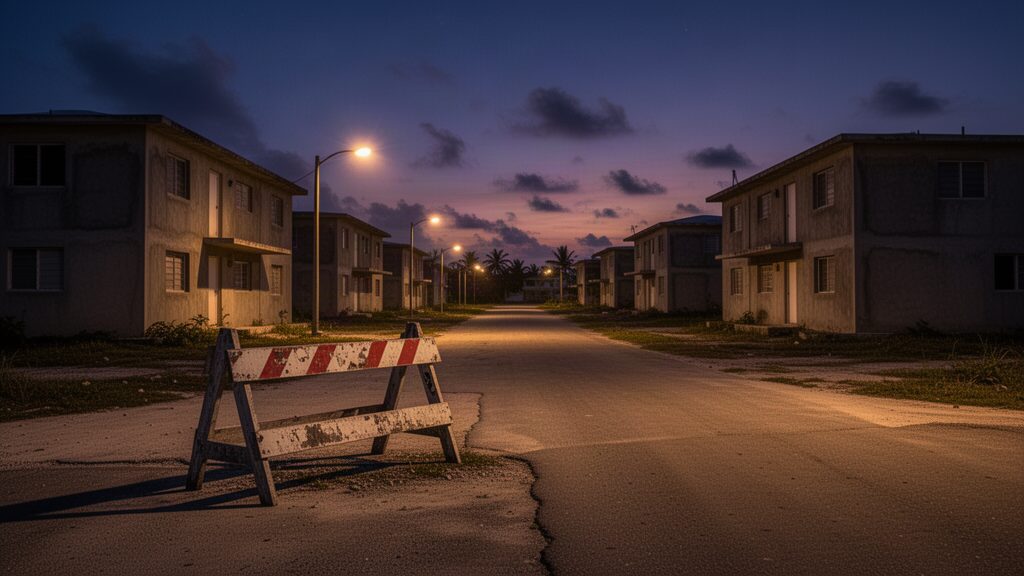
The Maloney lockdown is over, and the Government wants a victory lap for an operation whose own numbers barely fill a paragraph. At midnight on Tuesday the closed-area declaration and the 9pm-to-5am curfew over the Maloney Buildings Housing Development ended, two weeks after Trinidad and Tobago became the first country to test its new Special Operations Act on its own citizens.
President Christine Kangaloo signed two orders revoking the measures under Sections 11 and 14 of the Act. Neither order gave a reason. The explanation came instead from Prime Minister Kamla Persad-Bissessar, who said the police had decided the threat was diminished and that she simply followed their advice. Asked whether the operation met expectations, she answered with one word: yes.
What We Know So Far
Maloney was declared a closed area on November 10, the day after a shooting and a stabbing in the community. Police and soldiers moved in. Commissioner of Police Allister Guevarro cited intelligence about possible revenge attacks between rival gangs and video of women and children running from gunfire. When the President set out the grounds, she pointed to rising violent crime, illegal firearms, gang intimidation and the failure of ordinary policing.
The haul: about 600 apartments searched, five illegal firearms found hidden in a fig patch in an operation the Commissioner led himself, ammunition recovered a day earlier, and, according to Trincity/Maloney MP Camille Robinson-Regis, eight marijuana plants. The Commissioner himself has acknowledged that people targeted by the operation slipped through the police cordon.
On Monday night residents shouted “we outside” as police posts were dismantled. One woman who has lived there for 42 years said the curfew had kept her from evening church two Sundays running. Councillor Stephan Wattley had spent three nights at Red Hill Junction ferrying neighbours home because taxis would not run during curfew hours.
A Test Run on Real People
Wattley called Maloney “a test run”, and that is the most honest description anyone has offered. A whole housing development was locked down to prevent a clash that may or may not have come, and the State’s published return is a handful of weapons that a targeted search warrant might have found without confining thousands of law-abiding people indoors every night.
The Prime Minister’s parting words were a threat to gangs, that police would return “with more force”, and a warning to residents not to be misled by gangs or the Opposition People’s National Movement. Lumping the opposition in with gangsters in the same sentence is not a security policy. It is a political reflex, and it tells residents that criticism of the operation will be treated as disloyalty.
Robinson-Regis called the lockdown “wickedness in high places” and argued that the authorities had not followed the regulations they themselves wrote. Her colleague Marvin Gonzales demanded resignations, asking where the “big fish” were. The rhetoric is hot, but the question underneath is fair: what intelligence justified two weeks, and what did two weeks deliver that two days would not?
The Real Fight Moves to Court
Persad-Bissessar has dared the PNM and others who sent pre-action letters not to withdraw their challenges. Good. Social activist Wendell Eversley has already filed a constitutional challenge through a team led by former prime minister Stuart Young, and Attorney General John Jeremie has hired British constitutional barrister Lord David Pannick to defend the law. Robinson-Regis says the case will continue because a ruling is needed to stop the next community suffering the same treatment.
That is exactly right. The lifting of the curfew changes nothing about the power itself. The Special Operations Act still lets the State seal off a neighbourhood on intelligence it never has to show the public, and Maloney’s experience shows how thin the results can be. Until a court rules on where the limits lie, every community on the East-West Corridor is one shooting away from becoming the next experiment.